Wednesday, 5 September 2012

Digitising X-rays: the digitisation of the Biophysics collection


In this week’s post, I discuss some of the digitisation aspects of the project with special reference to the work of one of our digitisation contractors, MAX (previously MAX COMMUNCATIONS,) who digitised 4,000 of the glass and acetate material.

In October 2011, two of the digitisers from Max Ltd visited the archives in order to familiarise themselves with the collection and carry out some test scanning. The material was quite diverse: photographic prints, x-ray acetates, various sizes of glass plate negatives, folded negative rolls and 35mm mounted slides. The majority of this material required external specialists with the required expertise and equipment to undertake the scanning. A small test file was created composed of quarter plate glass negatives and x-ray acetates and sent to the Wellcome for approval. Both Iain Stringer, who would go on to digitise the collection, and David Cordery, head of Max Ltd, have prior professional experience of working with glass plate and acetate x-ray collections at various institutions  around the UK and we were fully confident of their ability to handle the fragile items and successfully scan them. The test images that were sent to the Wellcome were approved and scanning commenced in December 2011.

 The images were scanned at 300 dpi (dots per inch) at 8-bit (bit rate) RGB (Red Green Blue) using an Epsom V750 Pro scanner. This type of flatbed scanner is reliable and fast and from a preservation perspective, the scanner was suitable for digitising the x-ray acetates as the two- inch gap between the bed of the scanner and the top scanner head meant that it did not press onto the x-rays and so would not cause any further damage to the x-rays afflicted with vinegar syndrome (vinegar syndrome occurs when an acetate degrades and begins to oxidise creating a vinegar smell. The surface often begins to warp and crack and this eventually affects the emulsion. Unfortunately the process is irreversible and it is why digitisation is one of the most effective ways of preserving an accessible copy of the item.)
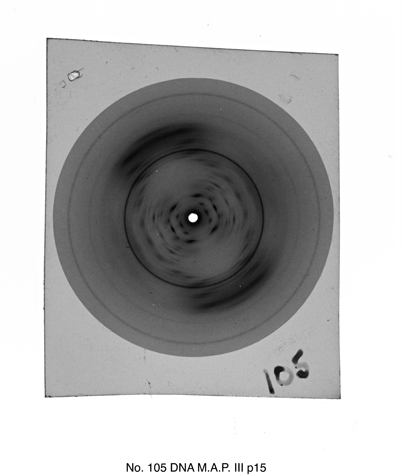
An example of an X-ray acetate diffraction image from the collection.  The  sleeve caption information has been added to the image. This diffraction image was taken by Wilkins around 1953-1955 and the likely source of the DNA originated from human subjects supplied by Leonard Hamilton and Ralph Barclay of the Sloan Kettering Cancer Center in New York.


I asked Iain to tell me about his experience scanning our material compared to his previous experience with similar collections. He said that the plates, in terms of general condition, were some of the best that he has worked with as hardly any were chipped or broken. The only slight issue that he encountered was that some of the slides were mounted with red strips, the adhesive of which had begun to seep and caused them to attach themselves to their transparent sleeves. In such cases, he therefore had to carefully remove the slide from its sleeve. This required a degree of perseverance, depending on the age and location of the adhesive strips on the slide.  

Regarding the x-ray acetates, I had assumed that this material would be trickier to scan considering the conditions that some of them were in. Iain surprised me by saying that for the purposes of scanning they were quicker to scan than the glass plates. Whilst care had to be taken in handling small, fragile and brittle objects like deteriorating x-ray acetates, the most time consuming element of scanning an x-ray was the post-production.

MAX Ltd provided us with images in three formats:  the raw TIFF original file, the enhanced TIFF amended file and a JPEG file. While enhancing an image can be difficult with regard to obtaining an authentic copy of the original, in a situation where the original is difficult to discern, post-production ‘clean up’ is necessary. The majority of the x-ray acetates retained a degree of visible content and by using Adobe Photoshop post production, it made it easier to enhance the original pattern of the x-ray and compensate for some of the surface damage caused by any deterioration.

Finally, I asked Iain what he thought of the acetate and glass material as a whole. He said:

“ I found the material quite interesting…I’ve learnt more about DNA than I have since school,, good thing about my job that I don’t have to concentrate on one specific thing. X-rays of DNA, diffraction, very interesting. They would definitely make a good print, stretched over a canvas, especially one of the really clear ones like ‘Photo 51’”

I agreed, diffraction patterns such as ‘Photo 51’ are visually striking though I personally am more in awe about the crystalline A-form DNA pictures as there is something rather mesmerising about the symmetry of these patterns. You can judge for yourself however, as these two x-ray patterns are shown below.


A-form DNA

B-form DNA

Sunday, 19 August 2012

Will the archives of the future be made of the strand of DNA?

The prospect of combining archives and DNA feels like a plotline of a Twilight Zone episode. What's exciting however is that it is a distinct possibility. The Guardian have just released a story about the DNA inscription of a book (  http://www.guardian.co.uk/science/2012/aug/16/book-written-dna-code) initially reported in the US journal, Science. The book composed of 53,000 words includes eleven images and a computer program. The 5.27 megabit collection of data created over several days was produced by Professor George Church of Harvard Medical School.

The method they used, in principle, was the same as digital inscription: encoding all the book information into a binary sequence. The DNA base pairs in this case representing 1's and 0's with Arginine (‘A’) and Cytosine (‘C’) representing zero, and Guanine (‘G’) and Tyrosine (‘T’) representing one. The team developed a system in which an inkjet printer embeds short fragments of artificially synthesized DNA onto a glass chip. Each DNA fragment contains a digital address code that denotes location within the original fiDNAle.

What makes DNA such a brilliant medium for storage is its data storage with estimates suggesting a gram of DNA can store 455 billion gigabytes. The data is easily readable and copied and maintains its stability for several thousand years.  

The possibilities are fantastic. To put this in perspective, most digital formats require an upgrade after five years with physical data storage such as DVDs having, at most, a twenty year life span. This is because of the constant change in informational software packages within sturdy digital formats, such as TIFFs and PDFs having 10-15 year maximum life span. A DNA code sequence is therefore more desirable than a digital approximate, but neverless it is an exciting development and will potentially rival the paper record revolution in record keeping. This is an exciting archival perspective.

As a cataloguer and digitiser of the DNA related material of the Kings college London archive such a development is one of a personal joy. It would feel wonderfully apt to have the papers charting the discovery of the structure of DNA are encoded into DNA for future generations.

Tuesday, 7 August 2012

August Project Update


The project is entering its final months and a quick update as it what has been happening is in order:


To date, 24,000 images have been produced by our digitisers which roughly breaks down as 4000 glass plate and acetate images and 20,000 images from the paper collection. Over the next two months the remaining part of the paper collection will be scanned. Sections that have already been scanned include papers from Wilkins’ early life, scientific working papers, correspondence with scientific colleagues, papers associated with the history of the research on DNA and sections of his autobiography.


Above, is a low resolution copy of some of the images that are being produced. The example is a postcard received by Maurice Wilkins from Francis Crick dated May 1955 and sent from Paris. The postcard reads: "Having a lovely time telling people about your work and my ideas! Hoping to see you in Cambridge for a quiet weekend - Francis".


Our main tasks over the next few months involve the construction of metadata and copyright and sensitivity checking. The latter is the most time consuming as a detailed survey requires a systematic check of all potentially risky material. Our catalogue descriptions are written at a level to summarize the contents of the physical file but because the images will be accessible individually an item level approach to sensitivity and copyright is needed to be certain that legally and ethically all necessary precautions are taken before publishing on-line. Needless to say this process is time-consuming and has proved to be the most taxing element of the project.


Apart from the construction of metadata and the sensitivity checking the only other main strand of the project to update everyone with is outreach. The project continues to gather interest from its social media sites (like the one I’m writing on now). Besides the blogs, the project has had a presence on Twitter and new images have been added to the project’s Flickr site. In May, the archives participated in a Radio 4 piece on the Wellcome Digital Library which was reported previously on this blog. Alongside this, we were privileged to have been visited by Raymond Gosling in March as part of a television documentary. It was wonderful to meet a contemporary of Wilkins and Franklin and hear from one of the key workers his own experience working at King’s at the time. We are quite fortunate to have a copy of Gosling's original 1954 PhD thesis, titled ''X-ray diffraction studies of Deoxyribose Nucleic Acid' which has been selected to be digitised as part of the King's College London Biophysics collection. 

Friday, 27 July 2012

New Flickr set of Glass Plate negative images


A new Flickr gallery showing some of the images that have been included in our current digitisation project is now available. The images have been selected from the glass plate negative series (KDBP/1/1) which contain a number of images documenting x-ray diffraction and other physical studies into DNA. The series dating from 1949 to 1984 contains significant landmark diffraction patterns of DNA including early crystalline A-and semi-crystalline B-forms in particularly 'Photo 51' created by Rosalind Franklin. Along with x-ray patterns there are also model representations of the structure and graphical representations of the King's team's findings.


An example from the quarter plate glass negative series. Slide is referenced "DNA and RNA models" and was produced in July 1964 (KDBP/1/1/5974/1)

The new Flickr set can be found in the link below:

Friday, 13 July 2012

The Library of Maurice Wilkins: Part 2


In this second instalment regarding the personal library of Maurice Wilkins, I have selected a number of books from the collection and added contextual information.


Hiroshima Diary by Michihiko Hackiya, 1955: An eyewitness account by a Japanese doctor about the impact of the atomic bomb on Hiroshima in 1945. Maurice Wilkins was a verment anti-nuclear campaigner and it is unsurprising to find this in his library. He campaigned for Pugwash, SANA and CND throughout his life, visited Japan in 1982 and carried out a series of talks on nuclear disarmament (see below)


Life Itself: Its origin and nature by Francis Crick, 1982: In this book, Crick postulates that life began outside the solar system and uses evidence accumulated from his career in molecular biology to support his view. They met in 1948 and remained in contact for the rest of their lives. Below is an image of a postcard Crick sent Wilkins whilst on his honeymoon.


The Atomic Spies by H Montgomery Hyde, 1981: This book focuses on the British-based spies who provided the USSR with information relevant for the construction of an atomic bomb. Wilkins had links with two of the convicted men. He knew Klaus Fuchs at Birmingham University, and was friendly with the family of Allan Nunn May. He did not however know that he himself was also investigated by MI5 as a potential atomic spy from 1951-1954 (see previous blog post for more information: http://dnaandsocialresponsibility.blogspot.co.uk/2010/08/maurice-wilkins-accused-of-spying-by.html).

Below, is an image of Maurice Wilkins, at a student anti-war protest in the 1930s.


Fallacy of Star Wars by Union of Concerned Scientists, 1982: This publication from 1984 provides an argument for opposing the development of a 'total ballistic missile defence' by the US Reagan administration. This issue was one that Maurice Wilkins campaigned against in the 1980’s along with the British government's procurement of Trident Missiles. The two issues are related to Wilkins' anti-nuclear campaigning and his role as president of Food and Disarmament International (FDI). Below is a photograph of Wilkins' campaigning against the deployment of cruise missiles in the United Kingdom in December 1982. 


Medicine's 10 greatest discoveries by Meyer Friedman and G. W. Friedland: This book features a chapter entitled "Maurice Wilkins and DNA". Friedman corresponded frequently with Wilkins over the chapter and the made the bold move to focus on his involvement in the discovery. However, this didn't deter Wilkins from making numerous corrections in his copy of the finished book. The 'red pen' corrections and comments of Wilkins are a familiar feature of his papers and are often beneficial in providing context to scientific notes which would have proved difficult otherwise. Below is an example of Wilkins' own personal research on the history of the double helix, charting the physical methods used to establish a molecular structure.


The Library of Maurice Wilkins Part 1


'A personal library is an X-ray of the owner’s soul. It offers keys to a particular temperament, an intellectual disposition, a way of being in the world. Even how the books are arranged on the shelves deserves notice, even reflection. There is probably no such thing as complete chaos in such arrangements.'


 Jay Parini, American writer and academic (b 1948-)


As part of the acquisition of Maurice Wilkins personal papers for the King’s College London archives, the family also donated an extensive part of his private library. This generous gift contains a plethora of non-fictional material ranging from his scientific career in biophysics to later work in nuclear disarmament. The collection, consisting of books, booklets, pamphlets and journal articles, can be found within the Archives Reading Room in the Strand Building and occupies ten shelves. As the above quotation states, a personal library can be a window to the owner’s soul and the Wilkins library collection certainly conveys a sense of Wilkins’ range of interests. 


The collection contains journal articles and leaflets from a number of publications. Some relate to his scientific career with off-prints from the Journal of Molecular Biology, while others reveal his interest in the relationship between art and science. Also included are a series of annual booklets from the Nobel Prize organisation, listing prize winners. 

The published books cover a diverse number of subjects but can be broken down into the following categories:

Science: life sciences, genetics, physics and biographical material

History: mainly the history of science, but also of ancient Greece, the Renaissance and the political and scientific history of the twentieth century 

Psychology and Philosophy: psychoanalysis and how the mind works, also alternative therapies and eastern philosophy, in particular the practice of yoga

Anti-nuclear: relating to the anti-nuclear movement, disarmament, nuclear conflict.


Friday, 22 June 2012

Anyone for Vegetarian Athletics?

The Vegetarian Brothers

Whilst, trawling through the autobiographical section of the personal papers of Maurice Wilkins I came across a remarkable pamphlet,"Vegetarian Athletics (What they prove and disprove)" by Henry Light, produced by the Vegetarian Society, features the semi-naked vegetarian wrestling champions, S V and E H Bacon mid-bout.


The pamphlet was part of the collected papers of Edgar Wilkins, Maurice's father, who was himself a committed vegetarian and keen exerciser. Trained as a doctor at Trinity College Dublin, he later concentrated on public health and preventative medicine and had a life long interest in the effects of diet and exercise on health. His papers were collected as part of Maurice Wilkins' autobiographical research, originally to provide the reader with a framework of how family characteristics were passed down through the generations.


In the first page of 'Vegetarian Athletics', Henry Light dispels the myth that vegetarians can "merely exist" but can be lusty and thrive. He states that there is a "great paucity of vegetarian athletes as compared with the innumerable host of flesh-eaters in the land, and thus realise that the numerical odds against us are analogous to those of a small village pitted against the entire nation. How often should we expect that little village to win? Once in a thousand years perhaps. Yet we vegetarian, competing for scarcely more than a thousand weeks, have secured amongst our innumerable triumphs the following formidable list of WORLD and NATIONAL RECORDS and CHAMPIONSHIPS [followed by a list of athletes and their achievements]"


The twelve page pamphlet makes interesting reading not only through its content but its wonderful use of language especially when describing non-vegetarians as "flesh-eaters" or lines such as "before coming a vegetarian he was an epileptic". It provides examples from recent times of world and national record holding vegetarian athletes similar to the wrestling brothers on the front. In some cases it provides a detailed break down of their diet such as Eustace Davies, mountain climber:


"Whilst training, except when visiting friends, his food consisted chiefly of:

Breakfast: Bread and butter, hot milk, potato, green salad and oil, and sometimes an egg.

Lunch and dinner: Cheese, Bread, butter, potatos, green salad and oil, milk-pudding, and stewed fruit and cream. 

The food used during the performance itself was principally of a liquid nature. For the first ten hours it was egg and milk. Thereafter milk and soda, lemon water, some tea and egg, and once or twice milky tea at inns in the valleys. Also stewed fruit and cream and milk pudding at three places; and two oranges." 

Davies was quoted by the author saying: "I owe you a great debt of gratitude; your advice was acted upon in toto, and I do not know of any other system of feeding on which I could have done the trick".  

The pamphlet is interspersed with general advice on the merits and practicalities of vegetarianism and also the  initial difficulties a former "flesh-eating" athlete might encounter when he first switches to vegetarianism. Henry Light at one point warns: "Before starting on a vegetarian system of living, one should be thoroughly convinced not only of its superior ethical value but its practicability, and be thoroughly determined after starting, for the mind has so great an influence over the body that the slightest wavering or doubt usually spells failure, and failure of course brings discredit upon the cause and oneself".